FIND DATA: By Journal | Sites   ANALYZE DATA: Help with R | SPSS | Stata | Excel   WHAT'S NEW? US Politics | IR | Law & Courts🎵
   FIND DATA: By Journal | Sites   WHAT'S NEW? US Politics | IR | Law & Courts🎵
WHAT'S NEW? US Politics | IR | Law & Courts🎵
If this link is broken, please report as broken. You can also submit updates (will be reviewed).

How Politics Reshapes How People See Their Own Personality

personalitypolitical preferencesself-reportSurvey ExperimentpolarizationPolitical Behavior@APSR14 R files3 DatasetsDataverse
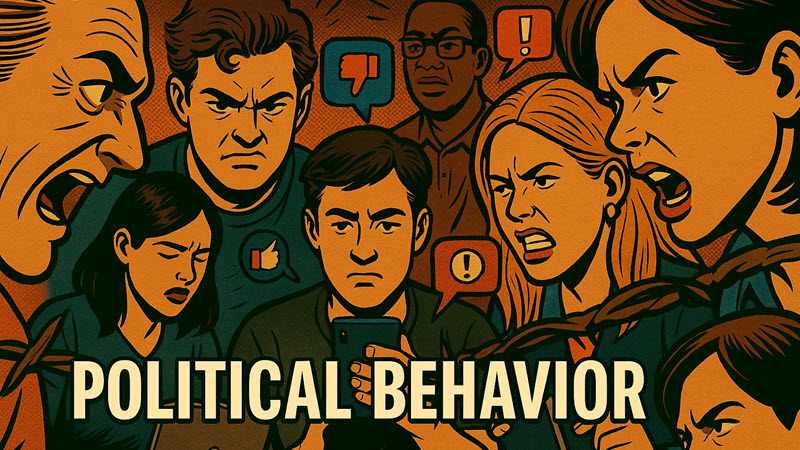
Political Behavior subfield banner

Politics and personality may shape each other, not just one way.

đź§Ş What Was Tested

The assumption that personality traits unidirectionally determine political preferences is challenged by the idea that citizens might adopt—or be motivated to report—psychological attributes that match their political views. The research tests whether self-reported personality and political preferences exert reciprocal causal influence.

📊 How It Was Studied

  • Preregistered panel analyses were conducted in three countries to track changes over time.
  • Two two-wave survey experiments used a subtle political prime placed at the beginning of a later survey wave to test causal directionality.
  • Political preferences were measured in an earlier assessment, and subsequent self-reported personality was measured after the prime.

🔎 Key Findings

  • Panel analyses across three countries provide evidence of reciprocal causal influences between self-reported personality traits and political preferences.
  • In the two two-wave experiments, a subtle political prime at the survey start produced self-reported personality profiles that were more closely aligned with political preferences measured previously.
  • The effects appear specifically on self-reported personality (self-perceptions), suggesting reporting or identity shifts rather than uncontested changes in underlying traits.

⚠️ Why This Matters

Concurrent measurement of personality and politics in political surveys may overestimate the causal influence of personality on preferences. Moreover, political polarization could be amplified if political opponents come to adopt—or to report—distinct personality characteristics or differing self-perceptions of those traits.
Article card for article: Reconsidering the Link Between Self-Reported Personality Traits and Political Preferences
Reconsidering the Link Between Self-Reported Personality Traits and Political Preferences was authored by Bert Bakker, Yphtach Lelkes and Ariel Malka. It was published by Cambridge in APSR in 2021.
Find on Google Scholar
Find on JSTOR
Find on CUP
American Political Science Review
Edit article record marker